If you have been told you have unclaimed property in California, and someone is offering to help you recover it, your first question is probably the right one: is this legitimate?
The honest answer is that the industry is legitimate and state-regulated, but not every operator in it is trustworthy. Knowing the difference protects you from giving away a percentage of your own money to someone who does not deserve it, and it also protects you from walking away from real funds because you assumed the whole thing was a scam.
If you received a specific letter and you are not yet sure whether it is real, our guide on what to do if you got an unclaimed property letter is the better starting point. This post assumes you have already verified the property exists and you are now evaluating who, if anyone, should help you claim it.
Here is what to look for.
The Industry Is Regulated by the State
California asset recovery is governed by the State Controller’s Office, the same agency that holds the unclaimed property. There are rules in place specifically because the state wanted to prevent abuse. A few key ones:
- Recovery firms cannot charge a fee greater than the state-set cap on the recovered amount.
- Firms must wait a statutorily defined period before they are allowed to contact owners about specific funds.
- Fees are contingency-based, meaning a legitimate firm does not get paid unless you do.
If a firm tries to charge you upfront, asks for a flat fee regardless of outcome, or quotes a percentage above the state cap, that is your first red flag. They are either ignoring the law or not licensed to do this work in California.
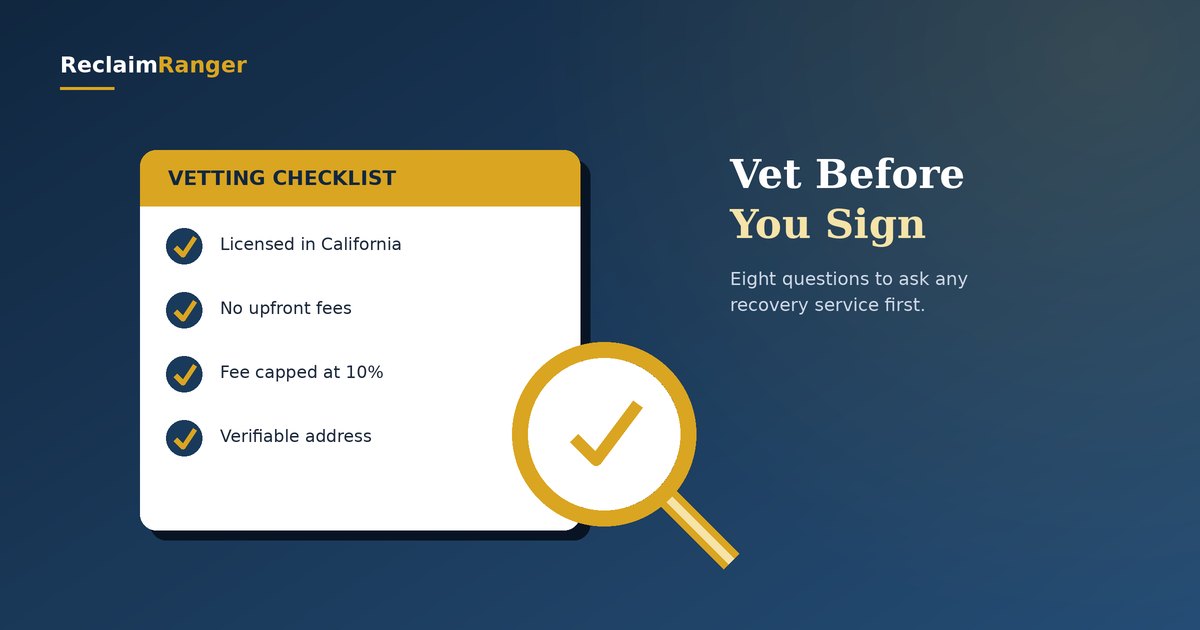
Eight Questions to Ask Before You Sign Anything
Use this as a checklist. A legitimate firm will answer all of these clearly and without pressure.
1. What is your California business license number? A licensed firm has one and will give it to you on request. You can verify it independently.
2. Where are you physically located? A real California asset recovery firm should have a California address. Out-of-state P.O. boxes are not automatically a scam, but they raise the bar for everything else.
3. How are you paid? The answer should be contingency-only. You should pay nothing if no funds are recovered. If they want a retainer, a research fee, or an upfront payment of any kind, walk away.
4. What percentage do you charge? California caps this. Any percentage at or below the cap is allowed. Anything above it is illegal in this state.
5. Who pays for the notary, certified copies, and filing costs? A legitimate firm absorbs these as part of doing business. If they try to bill you for notary fees or document preparation, you are paying twice.
6. Can you tell me exactly what property you are claiming on my behalf? A real firm will reference specific records from the California Unclaimed Property database. They should be able to describe the holder, the property type, and a reasonable range of the amount. Vague language like “we believe you may have funds” without specifics is a warning sign.
7. What happens if I want to cancel? You should have a clear right to cancel before any claim is filed. Pressure tactics or contracts that lock you in before work has begun are not standard practice.
8. How long will this take, and what will you do? A legitimate firm can walk you through the process: documentation gathering, notarization, claim filing, follow-up with the SCO, and disbursement. The whole timeline often runs three to twelve months depending on complexity.
If any of these questions get a non-answer, an evasive answer, or pushback, that tells you what you need to know.
Things That Should Not Concern You
A few things often make people suspicious that are actually normal:
- Receiving a letter you did not request. Recovery firms are legally allowed to contact owners after the statutory waiting period. A letter is not, by itself, a sign of a scam.
- A percentage-based fee. This is the model the state designed. The firm carries the risk of doing the work without payment if the claim fails.
- Being asked for identifying information. Once you have signed an agreement, the firm needs documentation to prove you are the rightful owner. This is required by the state, not optional.
The line is whether the firm is licensed, transparent, and operating within the state-regulated framework.
Things That Should Concern You
- Upfront fees, retainers, or research fees
- Fees above the state cap
- Pressure to sign immediately or claims that funds will be “lost” if you do not act
- Refusal to provide a license number or business address
- Out-of-state operators with no California presence
- Requests for your Social Security number or bank information before you have signed a written agreement
- Promises that they can recover funds the state database does not show
That last point is worth emphasizing. The California Unclaimed Property database is the source of truth. A legitimate firm works from that database. Anyone claiming to know about “hidden” or “off-the-books” funds the state does not list is either confused or selling you something that is not real.
If you are in the Coachella Valley, you can verify a local firm in minutes. We are based in Rancho Mirage and licensed through the State of California, and our license number is on every page of this site.
Why People Use Recovery Firms at All
If the state database is free to search and the claim forms are free to file, why does this industry exist?
Three reasons, and they are practical:
1. Most people do not know the property exists. The state holds funds for decades. Owners often only find out when a recovery firm matches a record to their current address and tells them.
2. The paperwork is heavier than it looks. Proving you are the same person as the name in a forty-year-old brokerage record, or that you are the rightful heir to a deceased relative’s funds, often requires documentation most people do not have on hand. Estates and heir claims in particular can require probate court orders, certified death certificates, and chains of documentation.
3. The state moves slowly. Even a clean, simple claim filed correctly takes months. A complicated heir claim filed incorrectly can take years, or stall out completely, while the funds sit in Sacramento.
A legitimate firm earns its percentage by carrying that workload for you and getting it right the first time.
How to Decide
If a firm has contacted you and you are not sure whether to engage:
- Verify the property exists yourself, using the free state database.
- Ask the eight questions above.
- Check the business license. California makes this easy.
- Compare more than one firm if the amount is significant.
- Trust your gut on pressure tactics.
You are never obligated to work with the first firm that contacts you. You are also never obligated to work with any firm at all. Filing a claim yourself is always an option, especially for straightforward cases where you have all the documentation already. Our guide on whether to use an asset recovery service or file the claim yourself walks through when each path makes sense.
The Bottom Line
Yes, California unclaimed property recovery is a legitimate industry. It exists because the state wanted private firms to help reunite people with their money, and it built rules to make sure those firms operated fairly. Most firms operating under those rules are honest. A small number cut corners or operate outside them. The checklist above is how you tell which is which.
If you would like to talk through a letter you received, verify a firm’s licensing, or have us look at a claim before you commit to anything, we are happy to help. There is no obligation and no fee for the initial conversation.